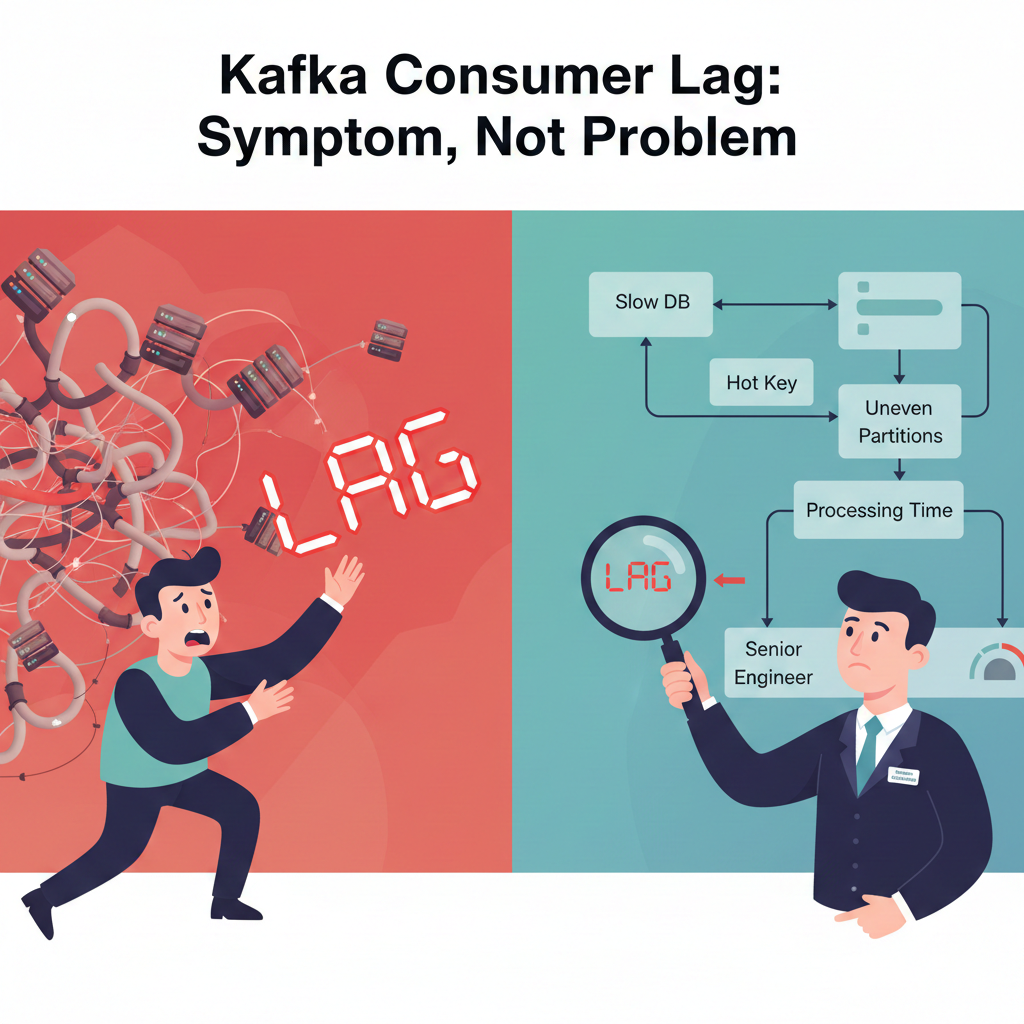
Kafka Consumer Lag Is a Symptom, Not a Problem
Kafka Consumer Lag Is a Symptom, Not a Problem
Short description:
Kafka consumer lag is one of the most misunderstood metrics in streaming systems. Teams panic when lag increases, celebrate when it drops to zero, and often miss the real issue entirely. This post explains what lag actually means, when it matters, and how senior teams reason about it in production.
The Obsession With Lag
If you’ve worked with Kafka in production, you’ve seen this moment.
A dashboard lights up. Consumer lag is climbing. Alerts fire. Slack fills with messages.
“Why is lag increasing?”
Lag becomes the villain.
But here’s the uncomfortable truth: lag itself is rarely the real problem.
Lag is a signal — not a failure.
What Consumer Lag Actually Represents
At its core, consumer lag is simply the difference between:
The latest offset written to a partition
The offset last committed by a consumer group
That’s it.
Lag does not inherently mean data loss. It does not automatically mean your system is unhealthy.
It only means consumers are behind producers.
Why Lag Exists by Design
Kafka is built to decouple producers from consumers.
Producers write as fast as they want. Consumers process at their own pace.
This buffering is not a flaw — it’s a feature.
Lag allows systems to absorb traffic spikes, downstream slowness, and temporary failures without collapsing.
Zero lag at all times is not a goal. It’s often a smell.
When Lag Is Completely Fine
There are many cases where increasing lag is expected and acceptable.
Batch consumers that process data periodically
Backfills and replays
Traffic spikes during peak hours
Downstream systems with intentional throttling
In these cases, lag is simply the queue doing its job.
Alerting aggressively here creates noise and alert fatigue.
When Lag Is a Real Problem
Lag becomes dangerous when it violates a business or operational guarantee.
Examples:
User-facing events processed too late
Fraud detection delayed beyond usefulness
Stateful consumers falling behind and timing out
The key question is not “Is lag increasing?”
The real question is:
“What does being behind actually break?”
The Hidden Causes Behind Growing Lag
Most teams assume lag means they need more consumers.
Often, that’s wrong.
Common hidden causes include:
Slow downstream dependencies (databases, APIs)
Uneven partition distribution
Hot keys causing single-partition bottlenecks
Long GC pauses or memory pressure
Synchronous processing inside consumers
Scaling consumers without fixing these issues just spreads the pain.
Partitioning: The Silent Lag Amplifier
Kafka can only scale consumers up to the number of partitions.
If one partition receives disproportionate traffic, one consumer becomes the bottleneck.
This shows up as:
Overall lag increasing
But only one consumer being overloaded
Without per-partition visibility, this is easy to miss.
Commit Strategy Matters More Than You Think
Offset commit behavior directly affects perceived lag.
Committing too frequently increases overhead.
Committing too infrequently makes lag appear worse than it actually is.
In some systems, consumers are processing data in-memory while lag dashboards scream.
The data isn’t stuck — the commits are.
The Mental Model Senior Teams Use
Experienced teams don’t ask, “Why is lag high?”
They ask:
Is lag growing unbounded or stabilizing?
How long until consumers catch up?
What SLA does this stream support?
Lag is evaluated in time, not offsets.
“Five minutes behind” is meaningful. “Two million messages behind” often isn’t.
How Lag Becomes a Debugging Tool
When used correctly, lag is extremely valuable.
Sudden lag spikes can reveal:
Downstream outages
Bad deploys
Schema changes that increased processing cost
Lag doesn’t tell you what broke — but it tells you where to look.
What Production-Ready Monitoring Looks Like
Mature Kafka setups don’t monitor lag alone.
They combine it with:
Consumer processing time
Per-partition lag
Error rates and retries
End-to-end event latency
Lag becomes one signal in a larger story.
Closing Thought
Kafka consumer lag is easy to measure and easy to misunderstand.
Teams that treat lag as the problem end up chasing numbers.
Teams that treat lag as a symptom end up fixing systems.
Once you stop aiming for zero lag and start aiming for predictable behavior, Kafka becomes far easier to reason about — and far harder to break.